

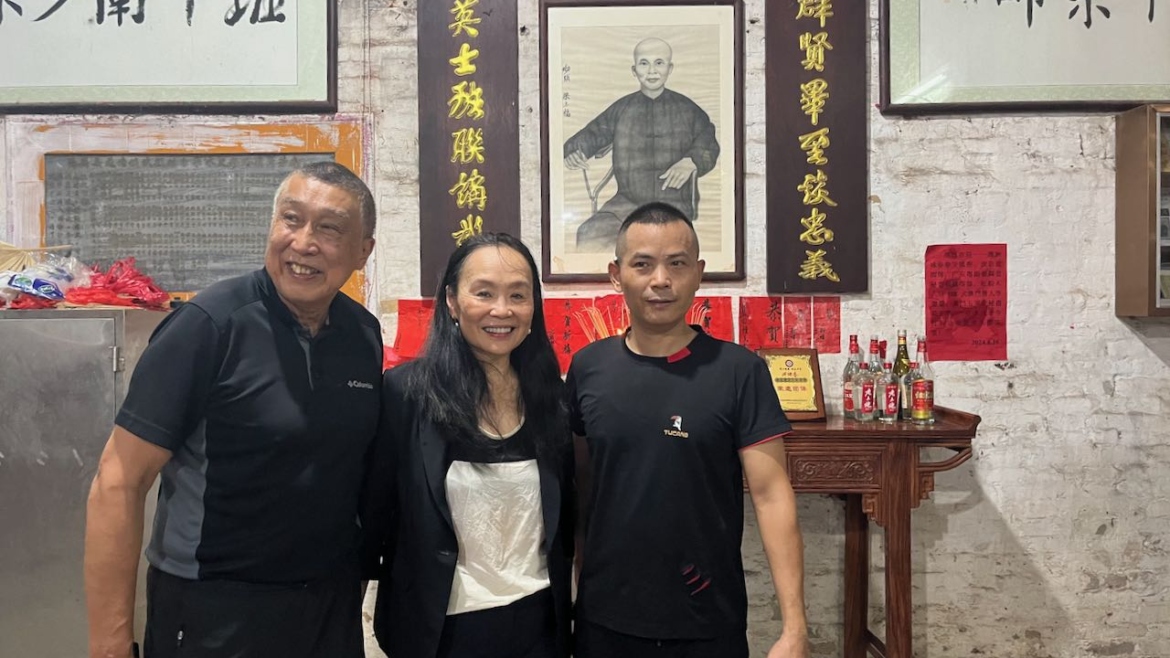
Visiting Leung Yee-tai’s remote home village in southern China we discovered a branch of Wing Chun almost lost in time.
Leung Yee-tai was one of two masters that influenced the kung fu that ultimately made its way down to the modern-day Wing Chun grandmaster, Yip Man. Our visit to his home village gave us some insight into what his Wing Chun may have looked like.
Leung’s place in Wing Chun history
Much of Wing Chun’s history is based on oral histories that are hard to verify. The style’s Shaolin Temple origins are dated around the late 1600s. Legend has it that five elders developed various southern Chinese kung fu styles there. They were multi-style practitioners that shared their techniques, always looking for ways to improve.
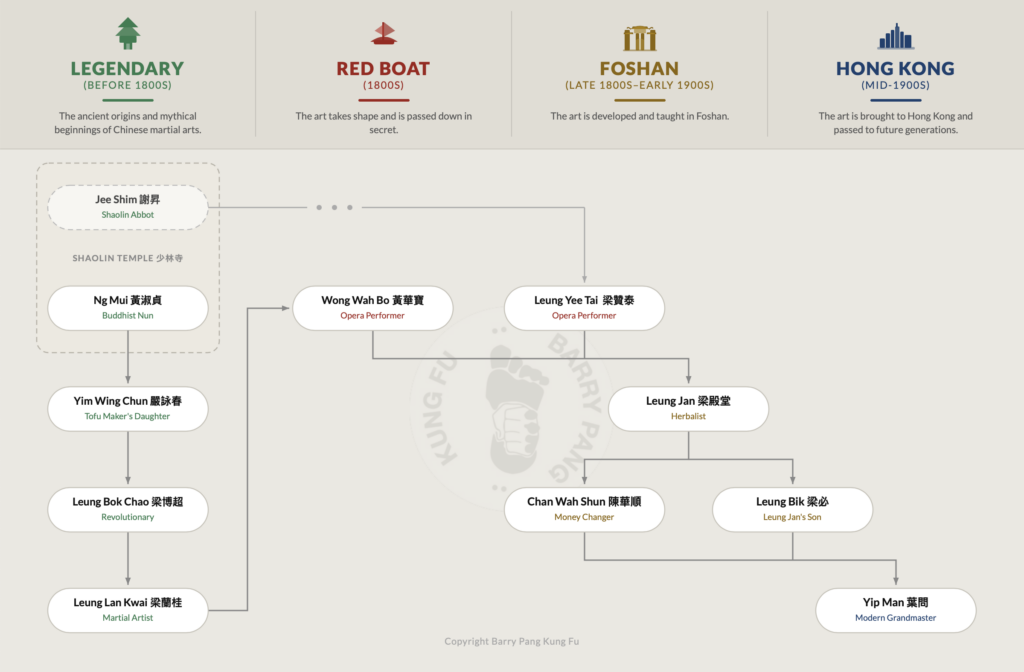
From that group, Ng Mui was the master credited with creating Wing Chun, sharing it with the other elders. Wing Chun was passed down through the generations, making its way to Leung Yee-tai and Wong Wah Boh, the masters that taught Leung Jan (1826-1901). From there it was Leung Jan’s students, Chan Wah Shun (1836-1913) and his son Leung Bik (1843-1911) that passed the style to Yip Man (1893-1972).
From here onwards we typically understand Wing Chun to involve three empty-hand forms, a wooden dummy form and two weapons forms. But looking back on the strands of Wing Chun that came before, it is clear that this was not the only interpretation of the style. Rewinding two generations back to Leung Yee-tai (梁二娣) and Wong Wah Boh, there is no doubt that their Wing Chun practice differed due to their diverse kung fu backgrounds.
Wong’s kung fu came from the Ng Mui line and had an emphasis on empty-hand practice and centreline theory. Leung’s traces back along the Ji Sin line and incorporated weapons developed in the Red Junk era, a period of domestic conflict requiring that militias be formed and armed. The Wing Chun long pole, a weapon that Leung mastered, seems completely at odds with the short-range nature of the style’s empty hands practices. But poles, sometimes equipped as spears, had long been a feature of imperial army training and weaponry.
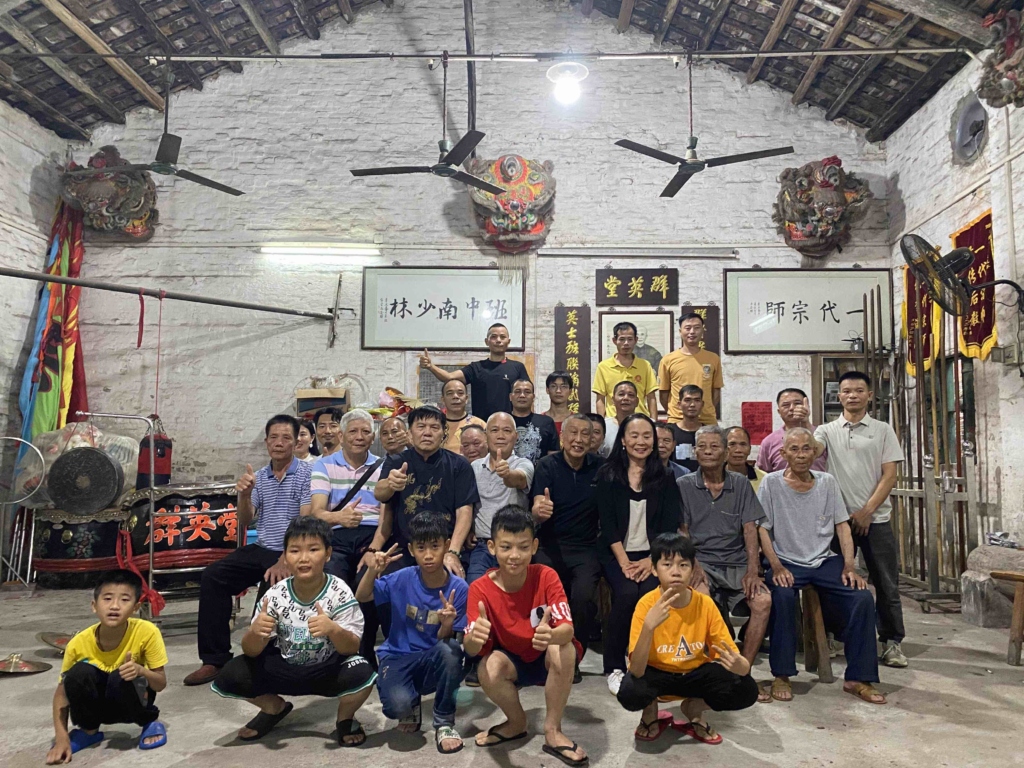
Our trip to Leung village
Our guide was a Wing Chun practitioner from Macau who said he had trained in Leung’s ancestral village. If true, this was a golden opportunity to trace the roots of Wing Chun’s ancestors.
We took an overland journey to an area just north of Liantangzhen (莲塘镇), winding through narrow roads that gave way to a remote village that felt largely untouched by modern development. The setting itself hinted at how traditions here might have been preserved in isolation.
At the centre of the village stood an old hall, part ancestral shrine and part community space, where gatherings were still held. It had the feeling of a living museum, not curated for outsiders but maintained for the people who belonged to it. We were excited to meet the head instructor and see his students begin to gather and prepare to demonstrate their kung fu.
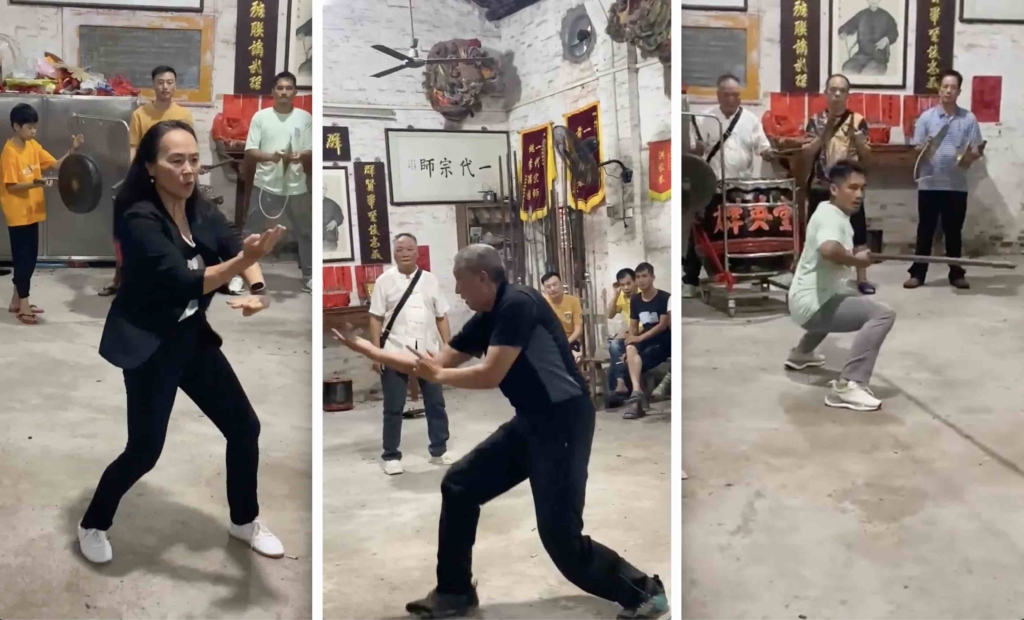
What we saw resembled a familiar structure: empty-hand forms and a long-pole form, but the expression was distinct. It was unlike what we expected. Movements were grounded, with stronger, more rooted stances and less visible emphasis on the centreline theory that defines much of modern Wing Chun. There was no 黐手 practice at all, and like most traditional kung fu schools, the concept of free sparring was a foreign one.
Footwear was minimal, often just simple sandals, yet balance and control were unaffected. Their poise came not from equipment or environment, but from repetition and habit formed over generations. Their footwork resembled in some way the Lung Ying stepping that our school had adapted in decades past.
Interestingly, they did not explicitly refer to what they practised as Wing Chun, despite the village’s direct connection to Leung Yee-tai. It existed more as a family or village system than a named style, suggesting that the labels we use today may have come later, as the art spread and formalised.
In return, we shared aspects of our own training. We demonstrated 黐手 flowing into sparring, which drew curiosity, if not full acceptance. In addition we showed the advanced Bil Jee form. The exchange was respectful, if cautious on both sides, each recognising elements that were both familiar and foreign.
Conclusion
The visit offered a rare glimpse into a branch of Wing Chun that has developed quietly, outside the mainstream narrative. While it differs in structure and emphasis, the underlying principles of balance, efficiency, and directness remain recognisable.
The connection to Leung Yee-tai felt less like a historical claim and more like a living thread—subtle, but present in the way the art is carried rather than how it is named. Since our visit, a young boy that gave an impressive demonstration has been acknowledged locally as the next grandmaster of this lineage, a reminder that even the most remote traditions continue to evolve.
Encounters like this challenge fixed ideas of what Wing Chun is supposed to be. Instead, they point to a broader truth: that the art has always been shaped by the people who practise it, adapting to context, need, and environment. Tracing these roots does not give us a single answer, but it deepens the story.
参看
Article: Written by R Zandbergs
Photos: Barry and Anne Pang
Main photo: Barry and Anne Pang with school master and portrait of Leung Yee-tai (2024)


 简体中文
简体中文  English (Australia)